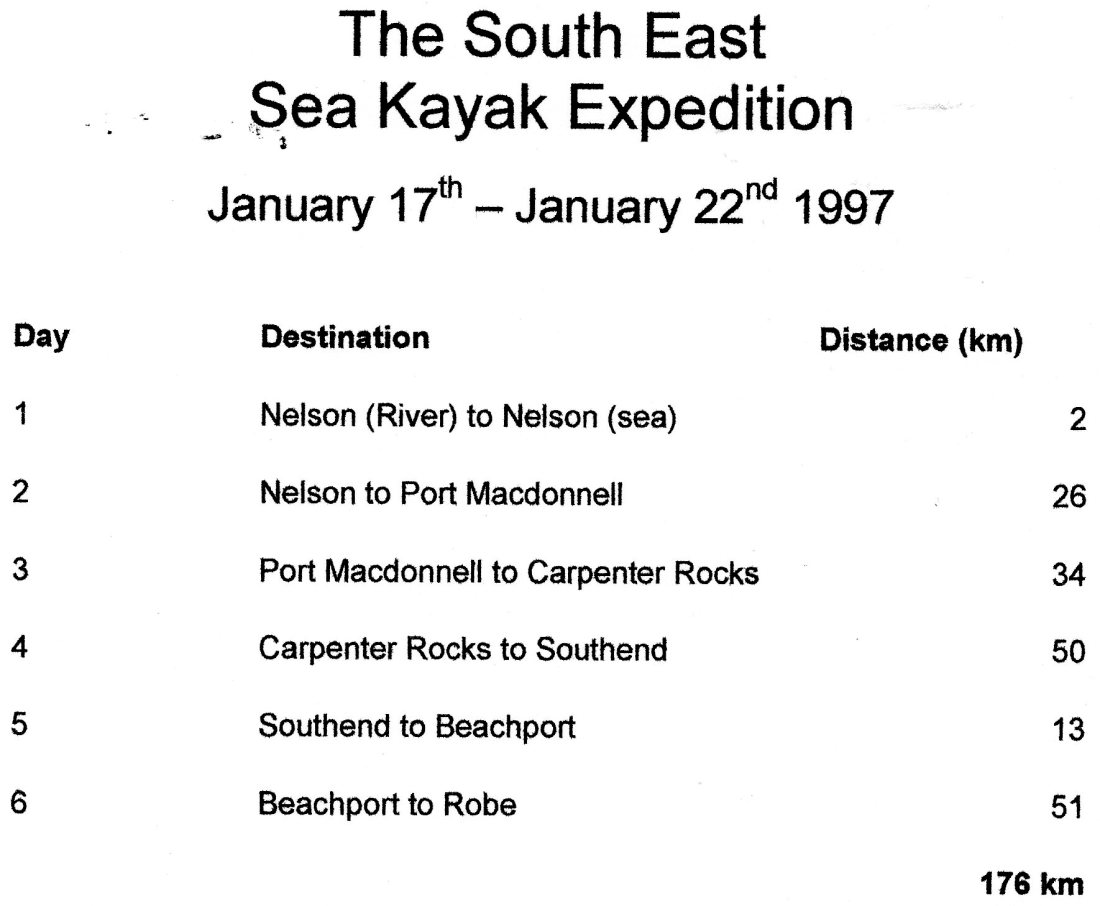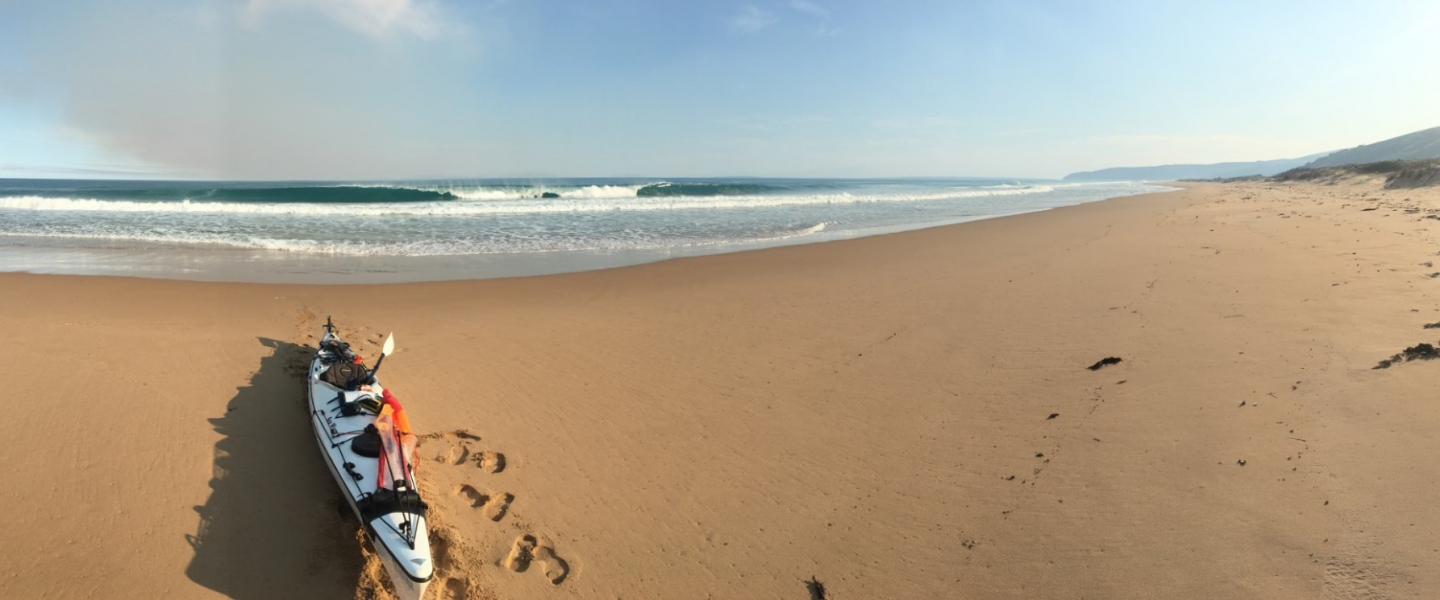

Here is Malcolm Hamilton’s account of the 6 Day expedition he and Gordon Begg took along the South East of South Australia.
January 17th -22nd 1997
Sea kayaker’s have an answer to that perennial problem of “what do I do? Where do I go for the Christmas Holidays?” They find a paddling companion and go sea kayaking in interesting and challenging places along South Australia’s fascinating coastline. One Such rarely paddled area that meets the above criteria is the South East of South Australia.
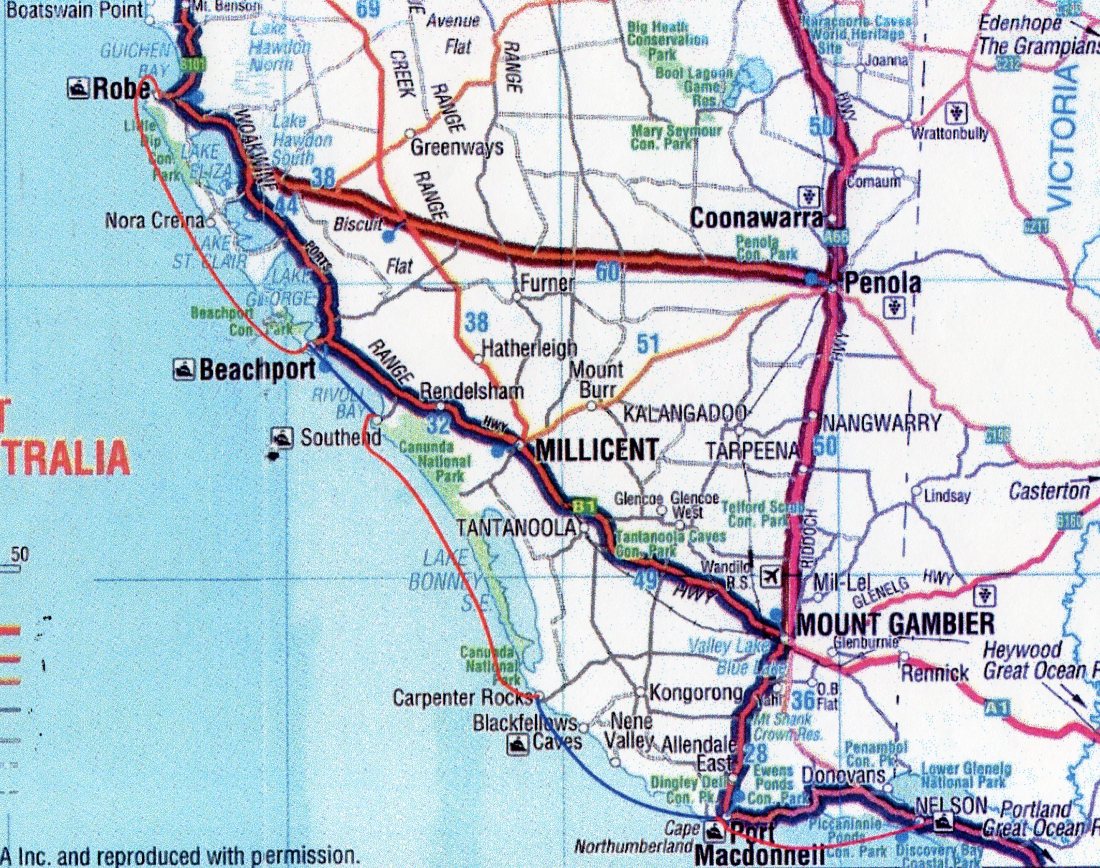
So Malcolm Hamilton and Gordon Begg set out to paddle from Nelson – just over the border in Victoria – to Robe during January 1997. Researched indicated that only one other person had successfully paddled this area. That was Paul Caffyn who traversed this area during 1981/82 as part of his circumnavigation of Australia. Research also indicated that the best time to paddle this area was early in the year to avoid the swells that build up by April and to be assisted by the prevailing SE Winds. Robe people like Roy Denning and Steve from “Steve’s Place” Surf Ship convinced us to change the trip from April back to January
On the afternoon of Friday the 17th January 1997 we were dropped at the Nelson estuary beach on the Glenelg River. As the sea and wind conditions seemed favourable Gordon suggested leaving for Port MacDonnell that afternoon. So by mid-afternoon we were paddling our fully-laden sea kayaks towards the surf zone at the mouth of the Glenelg River. The waves ‘out the back’ proved to be too big for us to handle. Both of us were flipped over backwards and tossed out of our kayaks. We swam back to shore to find our kayaks waiting for us on the beach. After a shore patrol we recovered most of the items that were washed from on or in our kayaks. Well it seemed like a good idea at the time.
Later we set up camp at the foot of the sandhills; cooked tea in the scrub to shelter from the persistent SE wind and retired to be early. An early start was scheduled so we could tackle the surf zone during the quieter hours of early morning.
We arose early. The surf seemed to have subsided. There were a few tense moments with a big set of waves ‘out the back’ but soon we were paddling parallel to the coast being assisted by following seas and wind. After a couple of rest breaks we had safely landed adjacent to the Port MacDonnell Jetty, a distance of 26km, in under four hours. Over lunch we discussed the possibility of pushing on to Carpenter Rocks. Eventually we decided against the idea so paddled back to the Woolwash Caravan Park. The tent were erected then it was off to enjoy a nice shower. Later we checked with the caravan park proprietor and with the local surf shop owner about getting out through the reef that is offshore from Port MacDonnell. Afterwards we walked to the breakwater to check our possible direction for the next day.
Favourable conditions greeted us the next morning and we were soon paddling outside the breakwater and inside the Wreck; a short-cut to get beyond the reef. This was no without incident as quite large waves had a bad habit of appearing out of nowhere which caused a rush of adrenalin as we paddled hard to avoid their breaking crests. Gordon was caught by one such wave but skilfully managed to avoid being dumped. From then on we were wary of these ‘surprises’, but still had several anxious moments when large sets would materialise out of the ocean to remind us of the intimidating nature of this coastline.
Port MacDonnell is a safe anchorage to South Australia’s largest rock lobster fishing fleet, so many crayboats were seen every day of the journey. However we were probably not as noticeable to them as they were to use. When we were seen, several boats changed course to check us out. Calingal 2 was curious about our presence. After seeing that we were OK and giving us directions to Carpenter Rocks, she left us to wonder about the entry into Bucks Bay. We skirted the large breaking waves over the reef then eventually lined up the two triangular markers, our guide through the entrance to the bay. It was a comfortable paddle to the beach through the crayboat fleet that uses this bay as safe anchorage
“The Dreamtime Voyage” is Paul Caffyn’s account of his kayak circumnavigation of Australia. In the book he states why he wasn’t impressed with Carpenter Rocks, describing it as an ‘ugly and unfriendly place.’ Any fears we may have had about the place proved groundless – people were certainly friendly towards us. Being a hot Sunday, the beach was crowded and several locals who were intrigued by our sea kayaks inquired as to our reason for being there. They also suggested we check out the local tavern for further advice. The hot weather had placed a visit to the pub high on our list of priorities. Later at The Rocks Tavern we introduced ourselves to Dave Miller, a local crayboat owner. Over a few drinks and a pleasant meal, we were given good advice about tackling the paddle to Southend. The tavern owner also informed us as to how he and a group of friends had watched us through binoculars make our entrance into the bay earlier that day. He also asked as to who was paddling the red kayak. I put my hand up for that. “You looked really tired,” he stated. You can’t hide anything these days!
By 5:30 next morning we were up and packing. Dave Miller and his son stopped by, on the way to their crayboat, to again assure us that conditions for the day were suitable. By 7 we were out of the bay and paddling in ideal conditions. The landmarks of Number Two Rocks, Number One Rocks and Whale Rock appeared regularly. Close to midday the wind picked up to 15-20 knots, so for nearly two hours we paddled non-stop. Then the monotony of sandhills of the Canunda National Park set in; the distant cape – our destination – seemed to take hours to draw nearer. By mid-afternoon the wind had eased considerably; the sea ‘glassed off’ and the rocky features of the coastline south of Cape Buffoon were a pleasant change of scenery. Just before 5:30pm to very tired paddlers eased their kayaks to the beach in front of the caravan park at Southend. And no wonder – it was a 50km paddle – a total of ten and a half hours paddling with only 45m rest.
The forecast for the next day was marginal for paddling and a change was imminent. We awoke to strong northerly winds and decided to put the paddle across to Beachport on hold. About 9am the winds abated slightly so we agreed to go. We were on the water at 10:15 and headed for a hazy Beachport. An hour later Beachport had vanished in the mist, so we stopped to take a bearing. Half and hour later we had a quick rest on the shoreside of Sherbert Rock. Beachport had reappeared so we aimed for the caravan park, arriving at the beach in front of it at 1pm.
The weather looked threatening, so we quickly pitched our tents. Before we had finished erecting them, light rain was falling, and not long afterwards quite heavy rain set in for the afternoon. This was used to our advantage as we hung ur paddling gear in the rain to wash the salt water from it. The rain cleared by later afternoon, so we walked into town to enjoy a meal at the Beachport Hotel. Again, another early night in readiness for a long last day’s paddle.
Just after 7am we were paddling the calm waters of the bay heading for the gap between Penguin Island and the mainland. The swell was up so we picked our way carefully through the reef breaks, then headed some distance offshore. Out the back the swells had increased, and it seemed like we were continuously paddling uphill. The crayboat ‘Panache’ changed direction to check us out. The skipper inquired as to whether I had a depth sounded on board. Hmmm! Do they make on to fit a kayak?
Nora Creina was out as a landing place in these conditions even if we just wanted to stop there for our lunch break. Conditions were now starting to take their toll – it was slow going in the choppy seas, large swells, and head winds.
Cape Lannes and its surrounding islands slowly became more defined. With the sight of large waves breaking over the reef we headed out to sea. Conditions had changed slightly – we were almost being assisted by the wind and the sea. The lighthouse appeared, then the obelisk. However, we were still unsure about heading inshore because of the uncertainty of the position of the channel between Cape Dombey and South Reef.
We’d wait to get on top of a large wave to give us an idea of what direction to take. Still uncertain we decided to make a run for it with the large following sea. Minutes later one crayboat, closely followed by another, passed a hundred meters or so to our left; both heading for Robe. So, we were on the right track! Around the cape we sighted the triangular beacon in the caravan park, our destination. Tired – It was more than a 50km paddle; 10 and a half hours paddling with little rest – but pleased to have completed the journey we landed just after 5:30 on the beach in front of the caravan park.
Then it was off to the Caledonian. The pleasant atmosphere of the Inn, a celebratory drink and a nice meal was a fitting end to a sea kayaking adventure.
Malcolm Hamilton, 1997